Showing posts with label Autopilot. Show all posts

Sunday, 13 October 2024

Graciosa to Lanzarote

Hi everyone,

We spent two nights at Graciosa.  The first day was spent relaxing after our early morning arrival.  On the second we went ashore with the crew of OCC sv Asteria.  We dinghied to the beach Playa de la Cochina.  From there Adam and I walked up to the top of Montana Amarillo, a ~170m peak with a great view.  After the walk we joined the ladies snorkelling the bay.  Lots of colourful fish.

Zen Again at Graciosa

Dinghying ashore

Playa de la Cochina

Playa Francesa anchorage from Montana Amarillo

Exploring Graciosa

That evening we had sundowners aboard OCC sv Saffron Star.  Thanks guys!

The following day we were up early for a dawn departure to motor to Marina Rubicon on the south side of Lanzarote.  The outlook for wind was poor so we decided to get the passage done.

Here are the plots...

Track (note the oscillating course)

Arrival

Graphs

Unfortunately our second Pelagic autopilot actuator failed soon after departure.  It had lasted only two months.  The failure left us with one very old Raymarine actuator.  This will constrain our cruising over the next few weeks before we fly to the UK where we have replacements waiting.

Fifteen minutes later the autopilot controller started misbehaving.  It wasn't holding course.  Requesting a 2 degree change of course produced a 10 degree course change after several minutes.  As the track above shows we oscillated around our desired course for some time.  Eventually we gave up and replaced it with the spare.  Pelagic autopilots don't need to be calibrated so it came to life immediately and held course.

We've now had two actuator and one controller failure in our 6-month old Pelagic system.  Unimpressed.  But Pelagic have provided great support and agreed to replace all of the failures under warranty.  So we're sticking with Pelagic for the time being.  We'll be collecting a new controller and three actuators in the UK.

Replacement autopilot controller masking-taped in place

It was a long motor to Marina Rubicon waiting for the old Raymarine actuator to die.  Happily it survived.  We anchored off the marina for one night before entering.  Nice to be back after previously visiting in 2021.  We've been joined by OCC Macaronesia cruisers Caballito del Mar, Metzi and Asteria.

For our first two days in the marina we were busy removing parts of the forepeak headliner.  Hooray for multitools!  Our multitool cut out the outboard and forward parts of moulded GRP headliner easily.  Less easy was tidying up the underside of the deck which had large areas of rock-hard resin 'bog' holding the headliner in place.  Hours of hard work with multitool, mallet and chisel.

Headliner Down!

The headliner had to come down to provide access to the forward mooring cleats.  With the headliner down we can easily inspect their mounting bolts.  Two are badly rusted and may be the source of our foredeck leak.

Zen Again at Marina Rubicon reception dock

After two days of hard work we joined the Caballitos and Metzis to hire a car and tour the island.  But that's another story!

Trust all's well where you are.


Saturday, 17 August 2024

St Pierre to Azores Passage Summary

Hi everyone,

Here is the summary of our passage from St Pierre in St Pierre & Miquelon to Flores in the Azores.  It was a passage of three phases - Grand Banks; Gulf Stream & Azores High - respectively delivering fog; squalls & champagne sailing.

Sailing into the sunrise

First some plots…

Track

Graphs

Wind

Speed

Temperatures

Here are the vital stats for the passage…

• Distances/Speeds
• Route Distance = 1180 nm
• Logged Distance = 1205 nm
• Track Distance = 1264 nm
• Duration = 10 days
• Average boat speed = 5.0 kt
• Average VMG = 4.9 kt
• Average day's run = 120 nm
• Best day's run = 124 nm
• Minimum boat speed = 4 kt
• Maximum boat speed = 6.8 kt
• Weather
• Minimum wind speed = 2 kt
• Average wind speed = 15 knots
• Maximum wind gust = 35 kt
• Apparent wind angle range = 60 to 150
• Seas up to 2m
• Swell up to 2.5m
• Foggy, then overcast, then broken cloud then clear skies
• Engine
• Total = 37 hours
• Driving = 37 hours (15%)
• Charging = 0 hours
• Consumption
• Water = 70 litres (7 litres / day)
• Fuel = 50 litres
• Failures
• Autopilot ram/actuator
• Water ingress into forepeak (perhaps via loose inspection hatch)
• Stars
• The boat!
• WindPilot vane gear (steered 60% of passage)
• Tides Marine SailTrack (made reefing sooooo much easier)
  * Rolly Tasker mainsail
  * SailnSea hydrogenerator
  * Starlink (despite 15-30 minute initial connection times)

The first phase of the passage took us across the Grand Banks.  It was foggy with SW winds giving us a close then beam reach.  Wind strengths varied from 7G10 to 18G27.  It was a cold, wet ride in 200m visability.  We used AIS and radar but encountered little traffic once clear of St Pierre.  No photos in the fog sadly.

We used the Grand Banks period to 'stress test' our new Pelagic Autopilot.  Regardless of the gain setting the pilot seemed to be moving the ram/actuator much more than our previous pilot.  The ram died after only 2200nm (from Virginia, USA), about half the lifetime of identical rams with our previous pilot.  We contacted Pelagic and they are providing a replacement and support to extend the life of each ram.  Like Raymarine rams theirs use plastic gears which are 'consumable'.  The Pelagic rams are less than half the price of the Raymarine equivalent.

Zen Again at the (temporary?) floating dock in St Pierre
on a rare fog-free day

Fog breaking up

Departing the Grand Banks

The second phase was in the Gulf Stream.  Here the weather was more variable.  Winds varied from SW to NW to NE, mostly 10G15 with squalls of 20G30.  We were between deep Lows passing to the N and the Bermuda/Azores High to the S, with troughs, ridges and small lows forming around and passing us.

We used the WindPilot for most of this phase.  So nice to have the boat steered silently!  We had three periods of very light winds when we motored and used a spare Pelagic ram.  During stronger winds we set the staysail / storm jib which worked very well.  It gets the power down much lower than the triple-furled yankee.  At such times we had the main double-reefed to trisail size.  The Tides Marine SailTrack made reefing much easier than our old 'slugs in mast slot' setup.

Kazi (the WindPilot) in control

Gulf Stream squally weather (with staysail)

Beautiful sunrises

Emailing via Starlink

Hitchhiker

The third phase was in the Azores High.  We were lucky that the High was pushed S by a large Low to the N.  This gave us 10G15 WSW winds all the way to Flores.  The wind only died as we approached the island and have been dead since arriving.

This phase was champagne sailing - nice breeze, sunny skies and lowish swell.  Great sailing!

Champagne sailing around the Azores High

Ready for arrival

Flores!

The approach and entry into Lajes Das Flores Marina is simple but only fully updated charts show the port modifications following recent hurricanes.  Inside the harbour visiting vessels may either anchor or lie alongside the older jetties, rafting if necessary.  There were 7 yachts lying alongside during our stay, with 3 rafting up.  There is currently no charge for anchoring or lying alongside.

Flores south coast

Approaching the hurricane-damaged outer breakwater

Around the new inner jetty

Approaching the inner harbour

Rafted alongside in the inner harbour

Starlink worked well for us throughout the passage.  Immediately prior to departure we transferred the unit from US-based to Europe-based since the Australian credit card we'd used originally was no longer accepted for a US-based unit.  Happily we have a UK credit card and we'll be in Europe (Azores & Canaries) for the rest of this year.  We also opted-in to Mobile Priority data to have access at sea.  The unit took much longer to connect at sea - 15 to 30 minutes - but once connected worked perfectly.  Here are our Mobile Priority usage & costs during the passage and for a couple of day after arrival, when we'd turned off Mobile Priority data.  At sea we used Starlink only for GRIB downloads, email and limited browsing with portable devices in Low Data mode.

Starlink Data & Cost

During phases 1 and 2 we used Starlink morning and evening for only 30 minutes to save power.  We used our SailnSea hydrogenerator - great kit!  During phase 3 we left Starlink on all afternoon since solar charging covered the additional power.  We departed St Pierre with 40% battery level and arrived with 100%.

We've spent our first three days here cleaning, tidying and reorganising stowage on Zen Again.  The latter is due to our moving between cold and warm climates, so major swapping out of clothing etc.  We've visited the friendly Club Navale in the port and walked up to the town.  The marina has good showers and laundry.

Looking forward to exploring the island.


Wednesday, 20 January 2016

Simon's Town - Autopilot Modifications

Hi everyone,
As mentioned in several posts previously (in particular here), we've had problems with our autopilot rams.  We have two complete Raymarine SPX5 systems with two Type 3 tiller rams. Two rams have lasted only 5000nm or so each.

The Raymarine man here in Simon's Town is very good and seems well connected with senior Raymarine staff in the US.  He looked at the system configuration - both software and hardware - and made several recommendations.  We have now completed implementing them all.

First we changed several configuration parameters, all of which are Dealer Calibration settings.  Our original calibration runs (separately for the two systems) resulted in Rudder Gain and Counter Rudder settings being set very high.

Rudder Gain reduced
Counter Rudder reduced
Rudder Damping unchanged
Secondly we had two s/s brackets manufactured.  These allow us to mount the ram on either port or starboard sides.  Keeping the ram on the windward side is recommended since it reduces arm extension which (we're told) should reduce wear-accelerating vibrations.  The mounts move the entire ram inboard which eliminates the 150mm arm extension we previously used.  This should further reduce vibration.

Thirdly we had a second pin fitted to the tiller, matching second mounting points on the two brackets.  These allow us to fit the rams 150mm further aft.  This gives us some redundancy (in case one of the pins detaches for example) and may perform better in some conditions.

Modified tiller with new brackets port & starboard
While here we've also discovered a company which manufactures "drop in replacement" rams.  Pelagic Autopilot appears to have a good reputation and I'm told their rams are longer-lasting.  We may well give them a try if the above changes don't stop our Raymarine rams wearing out prematurely.  Thanks to Jim of Canadian sv Haulback for the tip!


Other boat work done recently includes:
  • replacing two lost/damaged fenders
  • purchased iNavX Navionics charts for Caribbean and Europe
  • generated GoogleEarth imagery for Windward and Leeward Caribbean islands


Thursday, 24 December 2015

Simon's Town - Boat Maintenance Part 1

Hi everyone,
We've been using the last few days before Christmas to start preparing Zen Again for the Atlantic Ocean.

There are excellent services on-site here at False Bay Yacht Club.  The Raymarine man (Robert at Galley Electronic Services) is outstanding and the stainless steel man (Baden at BR Stainless) is too.  The chandlery is small but the staff are very helpful.

So here is the "done" list...

  • Polished all stainless steel
  • Washed manganese dust from yankee jib and mainsail
  • Washed manganese dust from all running rigging, end-for-ending sheets
  • Replaced worn webbing strap securing boom brake's "figure-of-eight" to boom
  • Cleaned the hull, skeg, rudder and propellor (keel still to do), watched by the occasional seal
  • Serviced the engine - freshwater system is still clear of black debris
  • Removed old autopilot ram mounting block (see below)
  • Cleaned the upholstery - we use AutoGlym which works very well
  • Replenished depleted consumables - engine oil, whipping twine, electrical tape etc
  • Obtained quotes for new anchor chain and another new autopilot ram
  • Repaired tattered ensign and club burgees

The short life of our autopilot rams has been one of two troublesome problems we've faced this year.  The other was the engine freshwater system problem.  Robert, the local Raymarine guy, is well connected to Raymarine HQ and has helped us figure out why the rams are wearing out so quickly.  Raymarine HQ say they have only seen wear like ours during their accelerated lifetime testing - where they deliberately work test units "to death".  So why is this happening?  Here's what we think is contributing...

  • Raymarine's "autolearn" calibration process doesn't always work well
    • In our case it set Rudder Gain and Counter Rudder parameters very high
    • It did so on both our autopilot systems which were calibrated independently
    • These settings caused the pilot to work very hard
    • We reduced the user-accessible Response parameter but apparently this doesn't entirely negate the effect of the two other parameters
  • We have a (Raymarine supplied) 150mm extension on the tiller pilot's shaft to reach the tiller
    • The longer the arm the more likely resonance will occur and accelerate wear
    • Our autopilot is mounted on the starboard side so on port tack extension can be large
  • We have the tiller pin at the recommended distance from the rudder shaft
    • Apparently this can be shortened to reduce the stroke needed by the pilot
    • This is only the case on boats with reasonably light helms (such as Zen Again)
  • I'm still not fully convinced the tiller pilot rams are designed for the same life as below-deck units, but am willing to try to optimise our installation to improve their longevity
We plan to address these issues by...
  • Manually changing the parameters via the "Dealer Calibration" settings (Done)
  • Fitting s/s mounting rails which move the outboard end of the ram inboard by 150mm
  • Fitting mounting rails (and electrical sockets) both port and starboard
  • Fitting two sets of mounting points on mounting brackets and tiller - one 150mm aft of the  nominal placement
  • A nice feature of multiple pins on the tiller and mounts on both sides is fault tolerance
If we can significantly reduce wear on the rams we'll be very happy!

Friday, 5 September 2014

Preparation for Cat 2/3 Offshore Safety Inspection

Hi everyone,
The last few weeks have been busy, fitting boat work into gaps in real work.  The focus has been on preparing the boat for offshore racing in the upcoming season.  Exactly how many races we'll do remains to be seen, but we like to prepare the boat well.  After all, the main difference between racing rules and cruising guidelines at FSC is that the former say "shall" and the latter say "should".

Both autopilots now mounted in the quarterberth
Like our earlier preparation for Cat 6 inshore racing this exercise hasn't been trivial.  The work done included:

  • Labelling countless items from boxes to cushions to floorboards
  • Buying more flares
  • Buying a new GPS-equipped EPIRB (since the battery on one of ours had expired)
  • Arranging for service of our Great Circle liferaft
  • Upgrading our manual bilge pumps
  • Replacing our danbuoy and lifering with an automatic inflating unit
  • Setting up new jackstays
  • Having our sail number sewn onto our side dodger panels
  • Further renewing and upgrading our first aid kit
  • Rearranging the area behind our instrument panel to make room for an AIS transceiver
  • Installing and configuring an AIS transceiver
The AIS transceiver is something we've done without until now.  We have had an AIS receiver for several years but a transceiver is recommended for offshore racing and far more effective than the radar reflector it notionally replaces.

The unit we chose is a Vesper Marine XB-8000.  This unit supports both NMEA0183 and NMEA2000 interfaces and has a WiFi access point.  We haven't used NMEA2000 on Zen Again previously but decided to try it out between the AIS, the VHF and one of our chart plotters.  We also feed our NMEA0183 instrument data into the AIS to make it accesssable via WiFi.

Vesper Marine XB-8000
The installation process was straight-forward.  Initially I tried connecting the NMEA2000 devices together without power applied to the NMEA2000 backbone.  This didn't work, so even if the devices on the bus don't need power from it the power is still necessary.  With that sorted out everything talked to each-other nicely.

We installed the AIS's GPS antenna behind the instrument panel, close under the side deck.  This is giving good signal strength and avoids yet another external antenna and long cable run.  The AIS's VHF antenna is dedicated to the AIS and is mounted on the pushpit.  The AIS receiver built into the VHF radio uses the masthead antenna so it will be interesting to compare their performance.

Connecting to the XB-8000 via either USB or WiFi is simple and effective.  We'll use USB for the laptop and WiFi for our iPads/iPhones.

XB-8000 AIS data overlaid in OpenCPN
OpenCPN showing data on one AIS target
On the iPad we run Vesper's WatchMate app which shows AIS information and allows configuration of the XB-8000.  We also use the iNavX chartplotter which supports AIS overlay.

WatchMate app on iPad (outer range ring is 8nm)
iNavX app on iPad with Navionics charts and XB-8000 AIS data overlay 
iNavX app on iPad showing instrument data from XB-8000 via WiFi
A consequence of installing the AIS was the relocation of our primary autopilot course computer from behind the instrument panel to the quarterberth.  That puts it above the backup course computer, so both are readily accessible.  Seemed to me that easy access to the autopilots is a good thing!

Saturday, 29 December 2012

Langkawi Cruise (days 1-4)

Hi everyone,
We departed Rebak Island marina on Boxing Day, sailing SE to the "fiords" at the southern end of Pulau Dayang Bunting.  We stayed there for two nights.  Yesterday morning we sailed to Fisherman's Cove (Selat Riang-Riang) at the southern tip of the Langkawi island group.  Today we sailed to Kuah.

Zen Again Track
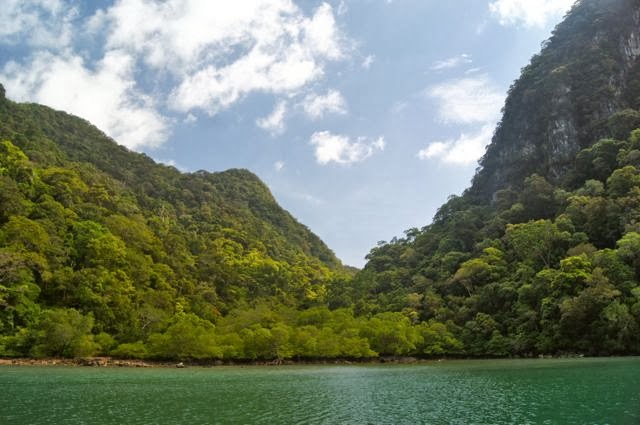
We had a great sail to the Fiord, eventually reefing the main when the wind got up to 20 gusting 25 knots.  Shortly after that we got into the lee of the island and had to motor the last mile or so to the anchorage.  The fiord is a narrow channel between the main island and a small offlying island.  The entrance is less than 100m wide, and only about 200m wide at its widest point.  We anchored at the widest point, tucked in near a small creek mouth (marked by the mangroves).

Great sail to the Fiords
Spectacular surroundings in the fiords
Great anchorage
Company aboard
Zen Again in the fiords
The fiord is a lovely anchorage, very well protected from sea and most winds.  The clouds were speeding past overhead at times but it was calm in the anchorage.  We saw many macaque monkeys, brahminy kites and several other birds.  We had the anchorage to ourselves on both nights.

Yesterday we motored from the fiord to Fisherman's Cove.  Along the way we calibrated the newly installed backup autopilot, doing the necessary 720 degree turns and zig-zags.  The cove is another small anchorage, this one protected by three islands which surround it.  On the day the wind came up to 20-25 knots at least, with good bullets coming through the anchorage.  The seas from outside penetrated a little, but it was very flat once the wind moderated a little.  We saw only one monkey but lots of brahminy kites (like sea eagles but with chestnut wings and back instead of dark grey).

Dawn at Fisherman's Cove
Today we had a great sail from Fisherman's Cove to Kuah.  We had a very nice 6-10 knot NE breeze.  The track shows we must have been having fun - we were tacking!  We're now anchored at 06 18.78N 099 50.80E in 6m over mud.

We expect to stay here for two nights before heading north to the Hole in the Wall anchorage on the NE coast of Langkawi.  We hope to spend New Year there, and probably won't have phone/internet coverage.