Friday, 27 March 2020

SaiLog YDVR NMEA-2000 Data Plotting

Hi everyone,
We've been keeping ourselves busy in isolation aboard Zen Again here in Gosport Premier Marina.  The topic of this post is how we plot the data we record on our NMEA-2000 network.  Yes, back to technical posts!

Zen Again's New Home

Voyage Recorder

Last year we added a Yacht Devices Voyage Recorder (YDVR) to our network.  The device is small with a microSD card plugged in the the end of the unit.  An LED shows whether data is being written.  The unit can also record audio, with a jack at the end of the unit.
YDVR - NMEA-2000 connector indicates its size

The YDVR records all NMEA-2000 data on the network.  On Zen Again this includes the following devices and data:
  • Vesper XB8000 AIS
    • GPS
    • AIS
  • Garmin GPSmap451 Chart Plotter
    • GPS
  • Garmin VHF300iAIS VHF Transceiver
    • AIS
    • DSC
  • Airmar DST800 Speed/Depth Transducer
    • Depth
    • Speed
    • Log
  • Airmar 220WX Weather Station
    • GPS
    • 3D Attitude
    • 3D Attitude Rate
    • Air Temperature
    • Air Pressure

As the above list shows, there's a lot of data.  We have three sources of GPS information - currently at 1Hz from the GPSmap, 2Hz from the Vesper and 4Hz from the 220WX.  AIS is another source of substantial data.  We are using a 32GB microSD card.

The YVDR is configurable to...
  • enable/disable NMEA-2000 recording (ie for audio only)
  • DAT/CAN file format
  • AIS on/off (AIS generates a lot of data)
  • ignore nominated NMEA-2000 PGNs (to ignore particular data types)
  • ignore address (to ignore particular devices)
  • enable/disable audio
  • adjust audio settings
  • & more
The YDVR comes with Windows and Mac OS X apps called YVDRconv.  The app translates the microSD data files into a variety of formats.  We convert to CanBoat/SignalK log file format which looks like this...

YVDRconv Output Format snippet

Zen Again's log files consume about 20MB/hour.  For our recent passage from London to Gosport the log file is about 800MB.  Given we were in a busy area much of this data may be AIS.

Having recorded the data the question was what can we do with the data?  Our goal was to produce plots showing boat performance and the environment in which we were sailing.  Searching the internet didn't produce anything which looked ideal, although there must be SignalK apps for this somewhere.

SaiLog Plot

We developed a Python script to add to our SaiLog python suite.  Example plots below show our passage from London to Gosport (click on each for full detail)...

London to Gosport Passage - Environment Plot 

The environment plot's wind sub-plots clearly show the nice SW wind we enjoyed on day 1, the light winds overnight and the slowly building NE wind on day 2 which was very gusty.  The water and air temperatures show it was indeed chilly!

London to Gosport Passage - Performance Plot

The performance plot's speed sub-plot clearly shows the effect of currents during the passage.  The heel angle sub-plot shows when seas were present.

SaiLog Plot currently plots selected data from our DST800 and 220WX devices.  All NMEA-2000 data is marked with its source address, which allows us to select the data.

Using YVDRconv

Using YVDRconv is quite simple.  On opening the app there's a welcome page for the conversion wizard...

YVDRconv page 1

The trickiest step is selecting the files to import on the next page.  The YVDR splits files into a time series of folders.  We had to select files from several folders, using the dates of each file to ensure we had all data from our passage time window...
YVDRconv page 2

On page 3 the output format is selected.  We use SignalK log format since we hope to be using SignalK soon, and the format is readily parsed in Python scripts.
YVDRconv page 3

On page 4 the output file is nominated together with various options...
YVDRconv page 4

On page 5 the selections are summarised...
YVDRconv page 5

Clicking Next starts the conversion.  Our 40 hour recording took about 10 minutes to produce an 830MB file.
YVDRconv page 6

On completion you have a number of options.  Take care if the output file is large!  I suggest the Finish button.
YVDRconv page 7

We expect to continue working on SaiLog Plotter to improve its capabilities.

Keep Well Everyone!

Saturday, 21 March 2020

London to Gosport

Hi everyone,
For more than nine months we've been planning to spend a year based in Gosport from this April.  With the onset of the coronavirus pandemic we thought hard about whether to stay on in London or proceed.   We decided to proceed.  There are few better places to isolate ourselves than on our wonderful boat!

Our original hope had been to cruise to Gosport over a week or so.  Given the pandemic situation it became a delivery passage.  We departed St Katharine's Dock at 0800 on Wednesday and arrived in Gosport at 2100 on Thursday. Here's our track...

Zen Again Track
And here are the usual statistics...
  • Distances/Speeds
    • Route Distance = 193nm
    • GPS Distance = 194nm!
    • Duration = 37 hours
    • Average ground speed = 5.0 kt
  • Weather
    • Minimum wind speed = 0 kt
    • Average wind speed = 10 kt
    • Maximum wind speed = 16 kt
    • Apparent wind angle range = 45 to 170
    • Seas up to 1m
    • Partly cloudy on Wednesday.  Overcast on Thursday with drizzle in fog.
  • Engine
    • Total = 24 hours
    • Driving = 24 hours
    • Charging = 0 hours

We were up and ready to go at 0730.  We departed SKD at 0800 and high tide was at about 0830.  On exit we gave Zen Again a last look at Tower Bridge before setting course down river.

Entering the SKD lock
Outer lock gate going down
Zen Again paying her respects to Tower Bridge
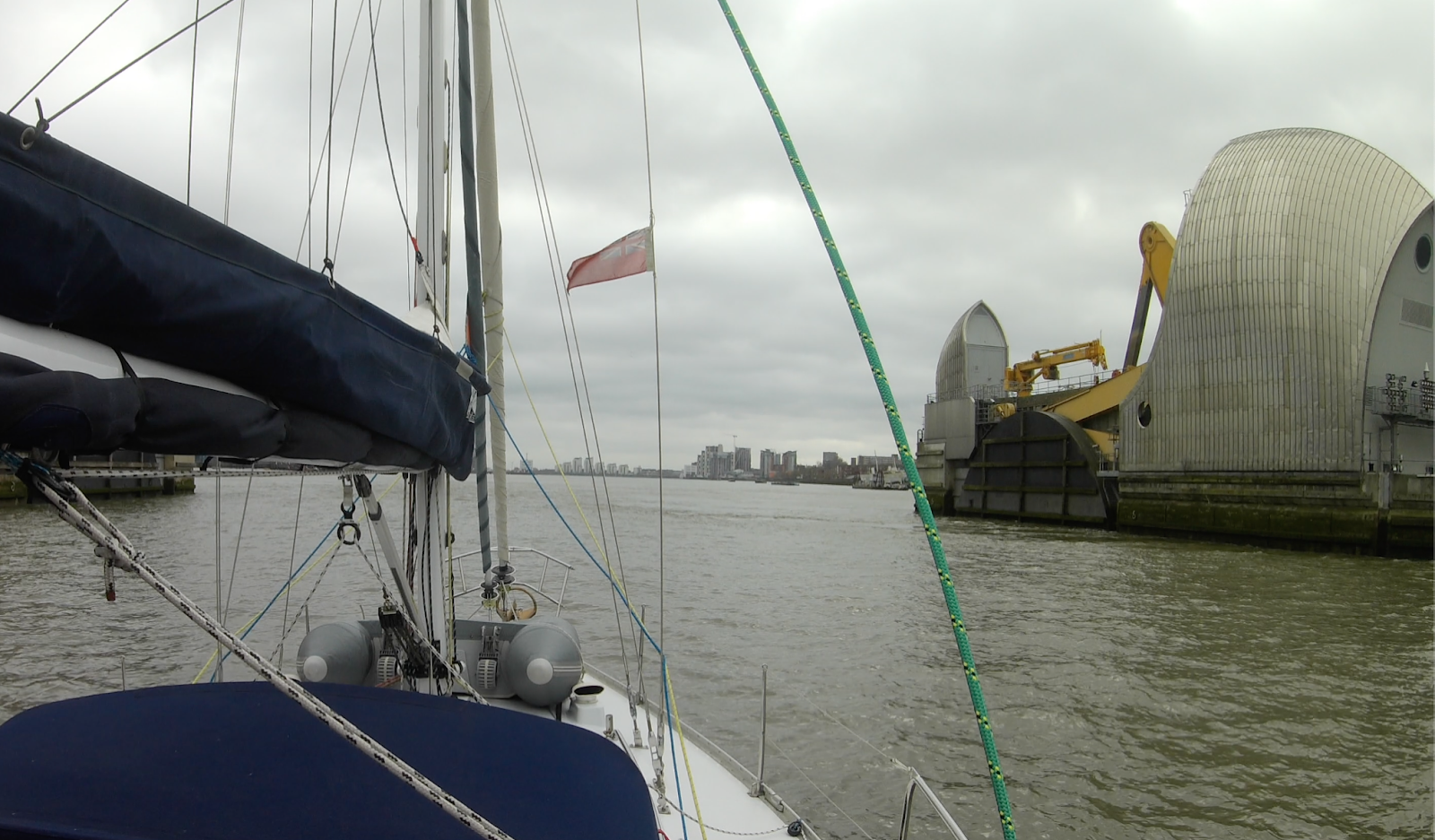
Through the Thames Barrier
We had a nice SW breeze of 10-15 knots to take us out of the Thames Estuary.  We set sail at Tilbury where the river's meanders lessen.  The clouds were slowly dispersing.

Sailing!
We sailed close past the Red Sands Sea Forts which I used to race to with my uncle and cousin in the 1980s.
Red Sands See Forts (WW2 Anti-Aircraft Platforms) 
A great sail out of the Thames Estuary
Our new kit performed very well.  The wind data from our Airmar 220WX seemed accurate.  SaiLog displayed the data nicely.  And iNavX worked nicely on the iPads in their Armor-X cases and mounts.

iPad Armor-X mount and case working well
By Wednesday evening we were around North Foreland and approaching Ramsgate.  We'd had a fantastic sail all day, some of it in glorious sunshine.  The breeze was cold though.

Passing Ramsgate the wind fell very light and the engine went on.  Sadly it didn't go off until we arrived in Gosport Marina.  We motor-sailed for several hours until the wind was too light.  A weak warm front was passing over us, bringing a NE wind perfect for our passage west.  Sadly it didn't arrive until Thursday afternoon.

The night was overcast and cold - down to about 6C according to the 220WX.   Many layers, thick socks, scarves and hats were applied.  We discovered ugg boots are excellent dry-weather winter sea boots - toasty warm!  The traffic in and out of Dover seemed as busy as ever.

Wednesday morning delivered a low overcast which descended to become fog for several hours.  Visibility was less than 1/2nm.  Our nav lights stayed on all day.

Fog along the south coast
In the afternoon a flock of small birds decided to circle us.  At least four landed aboard and scoured the boat for insects.  One of them seemed very weak and stayed with us.  One of its pals came back and seemed to console it but then flew off.  Sadly our little pal passed away and we buried it as sea.

Stray bird and Ugg boots
We entered the Solent at twilight.  There was a steady stream of large commercial vessels entering the Solent.  We kept outside the main channels and communicated with Southampton VTS and the Queen's Harbour Master (QHM).  Small craft enter and leave Portsmouth using the far western side of the channel.

Route into Portsmouth Harbour and Gosport Marina
Arriving in an unfamiliar marina at night is always interesting, especially in tidal areas.  GPS certainly helps.  The marina staff gave clear directions as we crept into the marina dead-slow and berthed without incident.

We're currently in the far NE corner of the marina.  From our berth we can see the nightly light show on the Spinnaker Tower.  We can also see the RN's new aircraft carrier HMS Queen Elizabeth.

In Gosport we hope we'll be able to go sailing frequently - if only for day sails in the Solent initially.

This afternoon we checked out the local supermarkets.  Like those in London there were many bare shelves.  We always keep Zen Again well stocked but hopefully the panic buying will settle down soon.

Trust all's well where you are!

Thursday, 12 March 2020

St Katharine's Dock Departure Preparations

Hi everyone,
Spring has sprung and we're preparing to depart St Katharine's Dock Marina in London.  After 18 months here it is time to set sail.  We've got a lot done while here, but suddenly there's a lot of prep to do before setting sail.

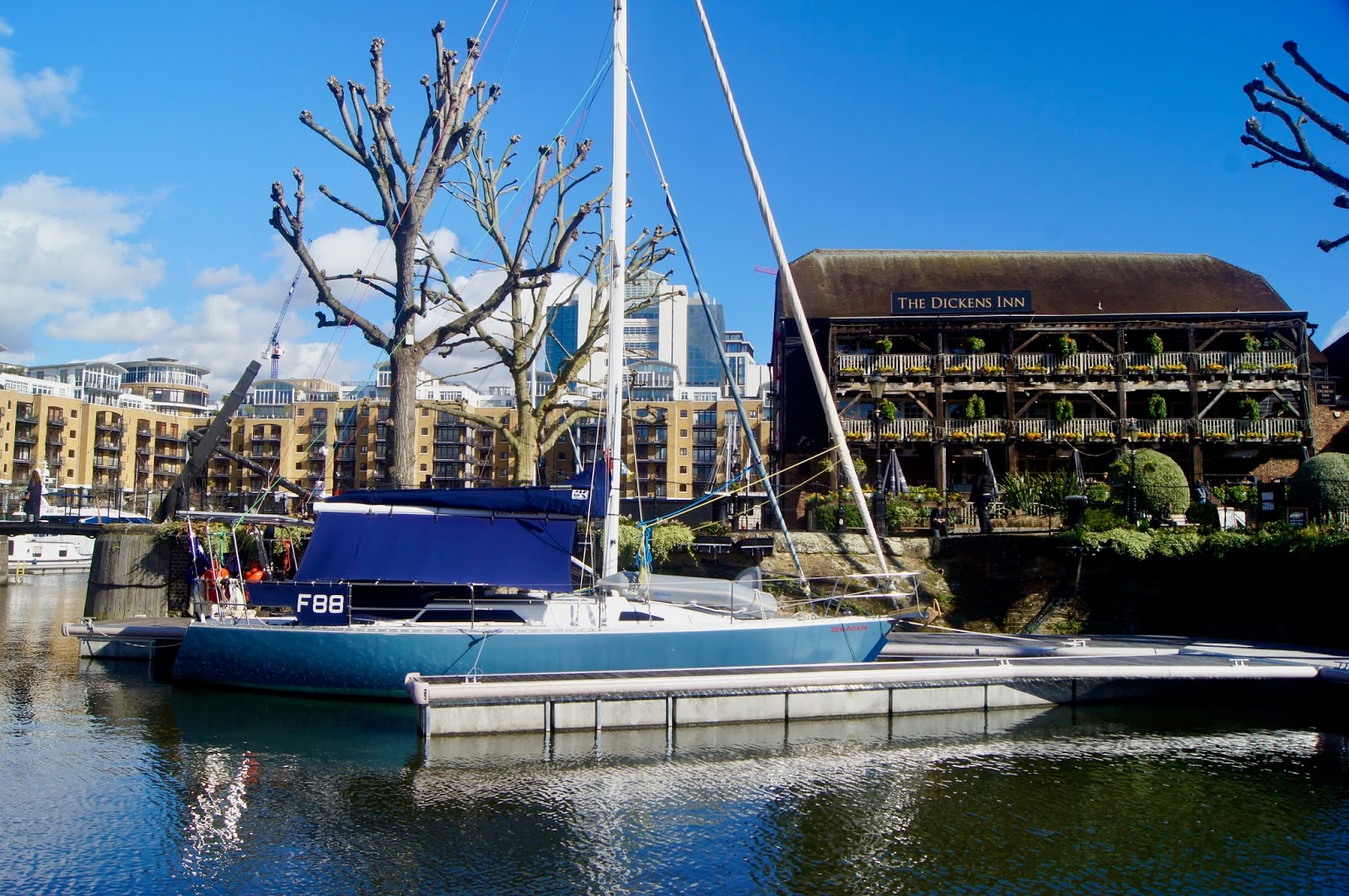
A week ago we moved from the eastern basin to the centre basin.  Even closer to The Dickens pub now!

Zen Again in SKD Central Basin

USB Power Outlets

Over the winter we replaced our ageing laptops.  The new Macbook Airs have only USB-C power and data interfaces which required different power connections.  We installed two power outlets for them (and our iPads and iPhones) in the pedestal / cabin table, and another in the navstation.

Two 18W USB-C + 48W USB Power Outlets
Interior View

iPad Mounts

We use our iPads for navigation using iNavX.  Previously they've been loose in the cockpit.  We've now installed mounts and waterproof iPad cases from Armor-X.  Very pleased with them.  In fact we like the cases so much we're getting iPhone versions too.  The mounts are compatible with GoPro mounts which allows us to combine them.

Armor-X iPad Mount
Port side iPad running iNavX on mount
Starboard side iPad running Vesper WatchMate

Headsail Cars and Mooring Cleats

Our jib & staysail cars were original, so about 35 years old.  The pin lifting mechanism of some of them was in poor shape and one was completely jammed.  Twas time for an upgrade.

We purchased a Barton 32mm end-stop and tried that for size successfully.  Recently we purchased four Barton cars and two track-mount mooring cleats.  We've wanted midships mooring cleats for years and finally have them!

Removing three of the old cars was easy.  The fourth was more fun, needing the Dremel to grind off the pin housing...
Old car with jammed pin housing ground-out
With the cars off we could clean up the track.  Wet'n'dry proved a good way to smooth and clean them, and give them a bit of a shine...

Clean track
Unfortunately the Barton track doesn't exactly match our old track.  Our track is slightly thicker.  The Dremel came out again to shave 0.5mm off the inside of the nylon inserts.  That done, everything fits!  And very importantly the cars can't reach the coachroof windows.

New cars and cleats mounted
Nice new moveable mooring cleat

In addition to the above we've done numerous other smaller jobs.  Some of these were...

  • Clean under all cabin sole boards
  • Inspect house batteries and all heavy-gauge wiring
  • Rig headsail sheets, staysail & reaching sheets
  • Rig boom brake
  • Rig jackstays
  • Rig mainsail reefing lines
  • Rig MOB / outboard hoists
  • Check all deck-level shackles
  • Mount PVC tube to hold boat hooks, dinghy oars, broom etc
  • Replace worn shock cord on our boom tent
  • Replace various UV-degraded fittings
  • Inflate dinghy
  • Test inflation all life jackets
  • Add/check batteries in torches, hand-bearing compass, temperature sensor, multimeter etc
  • Test EPIRB, AIS MOB & electronic flares
  • Inspect pyrotechnic flares
  • Inspect bilge pumps
  • Fit mounts for new video cameras
We also filled three empty diesel jerry cans when the fuel barge conveniently turned up nearby.  This was our first new diesel since filling in Dunstaffnage in Scotland.  We serviced the engine at the start of winter and ran it for an hour each fortnight during winter.  Recently we also swapped an empty 13kg propane tank so now have two full tanks aboard.

Our floating home is reverting to a sailing vessel at last!