Showing posts with label AIS. Show all posts

Saturday, 5 November 2022

Curacao to Santa Marta Passage Summary

Hi everyone,

We arrived in Santa Marta at 1700 local time yesterday after a pretty good passage.  The weather window we took turned out very well.  The seas were often boisterous due we think to wind against current, but there was plenty of wind to keep us powering along.

Westward!

Here are the usual plots...

Overall Track

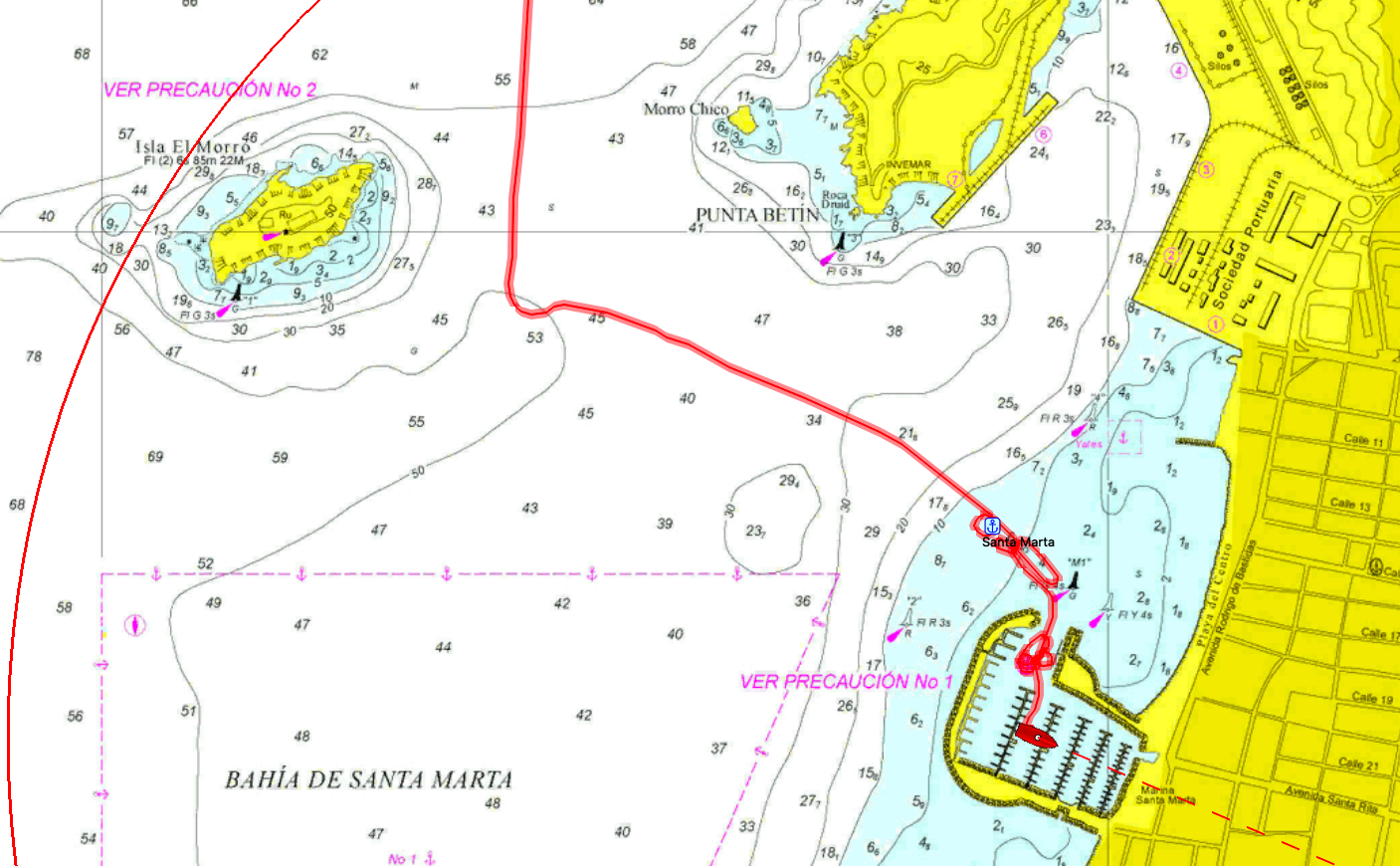
Arrival Track

Passage Graphs

Our track took us N of Aruba which suited our preferred broad reaching angle and kept us in deep water.  We could have gybed a few hours earlier but we kept to our strategy of a single gybe in the passage.  As we passed the cape we had periods of counter and favourable currents.  The sea state made these changes pretty obvious with boisterous seas during counter-currents.

Here are the vital statistics...

  • Distances/Speeds
    • Route Distance = 390nm
    • Log Distance = 396nm
    • Track Distance = 385nm
    • Duration = 3 days 1 hour (73 hours)
    • Average boat speed = 5.4kt
    • Average ground speed = 5.3kt
    • Average day's run = 133nm (through the water)
    • Best day's run = 137nm (5.7 kt)
    • Minimum boat speed = 4 kt
    • Maximum boat speed = 7 kt
  • Weather
    • Minimum wind speed = 5 kt
    • Average wind speed = 17 knots
    • Maximum wind speed = 28kt
    • Apparent wind angle range = 120 to 170
    • Seas up to 2.0m
    • Swell negligible
    • Thunderstorms nearby, then heavy rain showers, then sunshine
  • Engine
    • Total = 4 hours
  • Failures
    • None
  • Stars
    • The boat!
    • Starlink for accessing GRIB files and email
    • SailnSea SailingGen hydro generator charged our batteries from 25% at start to 100% after 2 days
    • Icom IC-7300 SSB for 12 hourly position reporting net with friends
Starlink performed very well.  We used it for two 30 minute periods daily, primarily to get email and download GRIB files.  It connected every time we powered it up on the passage.  We now appear to be using the ground station in Colombia since the ads on youtube are in Spanish!

Our new Vesper Cortex AIS system also performed very well.  We were picking up AIS signals from vessels way inland...

AIS targets 100nm up river!

Unusually for us we sailed most of the passage under yankee alone.  Although the winds weren't especially strong the seas were often confused and this configuration seemed best for the WindPilot.

Sailing under Yankee alone

As we approached Colombia the wind started to die.  We hoisted the main, first with two reefs, then one, then none, with more and more yankee.  Eventually it was clear we'd need to motor in to arrive before dark so the engine got a 3 hour run.

Colombia Ho!

On arrival in Santa Marta Bay we called Port Control on VHF 16.  They gave us permission to proceed to the marina.  We then called the marina on VHF 72 and they had us wait outside while they sorted out a pen assignment for us.  The wait stretched so we tied up at the fuel dock for a short time.  We got into our pen on D jetty shortly before rain started.

Approaching Santa Marta

The marina handles clearing in and out for yachts.  They certainly did an efficient job for us, with everything completed overnight.  The marina is neat and tidy with good showers and very cheap laundry facilities.  We spent this morning doing our laundry and tidying up the boat.

Later we walked into town which is right beside the marina.  We went with the Ceruleans to the Mobistar office where we arranged SIM cards and prepaid plans for our phones very cheaply.  Very pleased that Nicki spent the last year studying Spanish!  We followed that up with coffee and later with lunch.  Prices are really cheap and the coffee and food is good!

SIM & 8GB deal for 25,000 pesos (about AU$8)

There's a strong police presence in the city.  Sadly quite a few apparently homeless folks on some streets.  The city is busy and has a nice vibe.  The marina appears to have very good security.  Looking forward to exploring the city over the next few days, after which we hope to start touring inland.

Lots of motorcycle police around here

Trying out a Santa Marta cafe (about AU$8pp)

Street art

Hope we don't meet one of these in the jungle!

Trust all's well where you are!


Saturday, 29 October 2022

Vesper Cortex M1 AIS Onboard

Hi everyone,

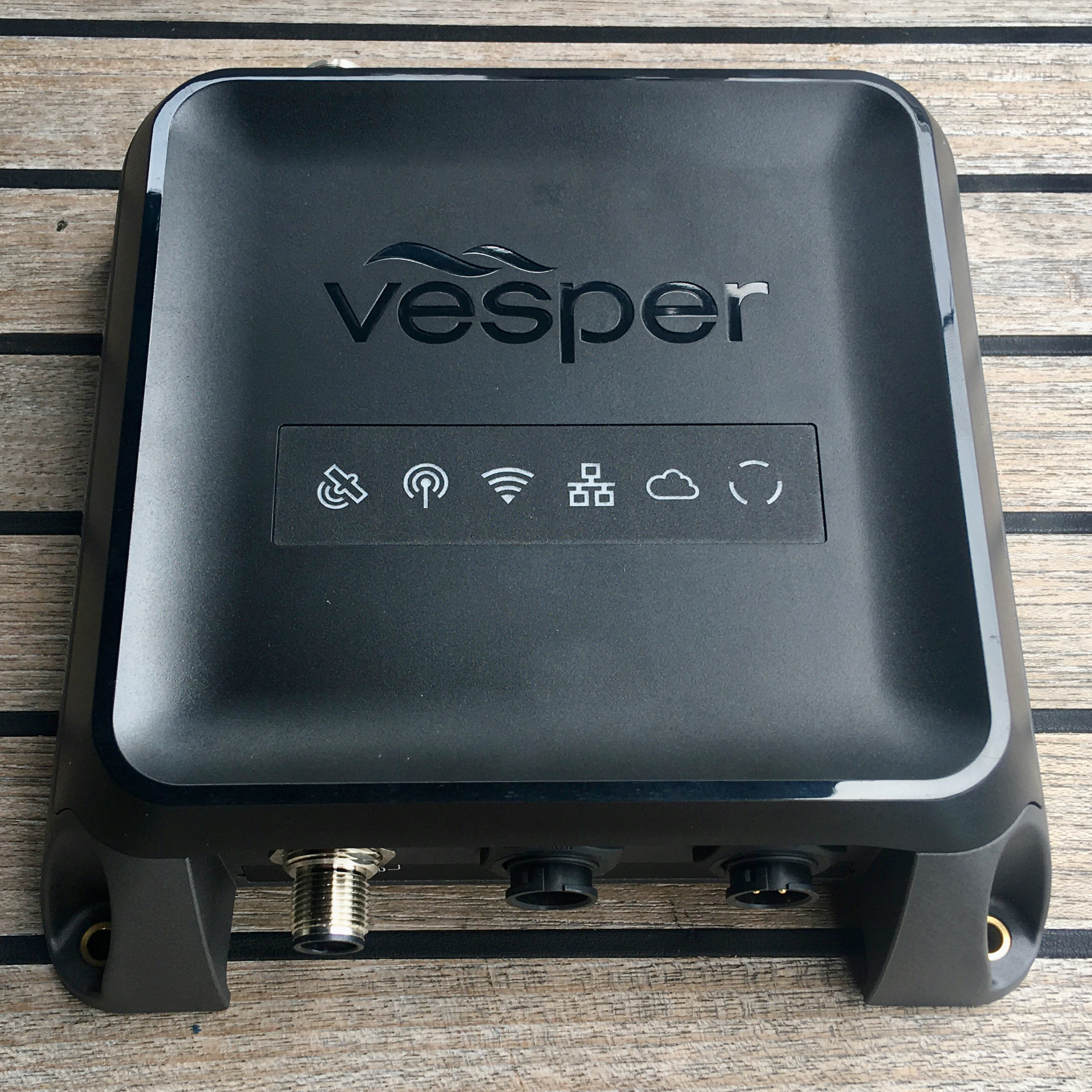
This is a technical post.  It describes the installation of our new Vesper Cortex M1 system.  We purchased it from the US and had it Fedexed to us here in Curacao.  Our previous AIS was a Vesper XB-8000 which was great but its GPS signal has been gradually degrading.  It had survived several lightning near-misses which may have accelerated its demise.

Cortex aboard

We purchased only the Cortex M1 hub which inhibits its use as a VHF radio.  With a handset it becomes a Cortex V1 with fully functional VHF DSC radio in addition to the M1's AIS and a lot more.  The hub includes a connection to an external VHF and an internal splitter - very nice.

Our configuration (core unit only) gives us:

  • Class B+ (5W SOTDMA) AIS
  • NMEA2000 and NMEA0183 gateways
  • GPS/Galileo/Glonass/Beidou-capable high-speed GPS
  • WiFi hotspot
  • Mobile SIM for automated vessel monitor messaging to the Vesper 'cloud'
  • Speaker and loudhailer outputs (alarms plus monitoring of VHF ch 16)
  • CortexOnboard app for our phones & tablets

It took about a week for the package to arrive from the US, mainly because it was stuck in Puerto Rico over a weekend.  It was then in Curacao customs for a week while they processed our duty-free Yacht In Transit papers.

It's aboard!

Out of the box

Removing the XB-8000 then installing and initial cabling of the Cortex was straight-forward but took half a day.  We initially didn't mount the GPS antenna since we knew that wouldn't be fun.  With power applied we connected from an iPhone running the CortexOnboard app.

Connected to WiFi
  
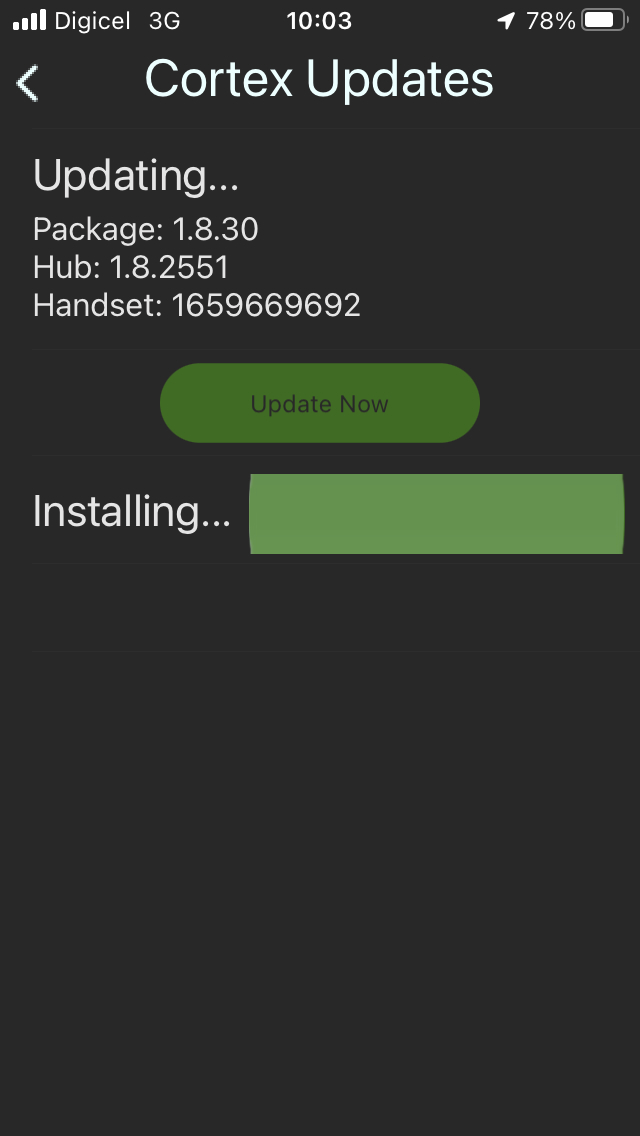
The next step was to update the software.  We did this using our Digicel mobile data.  All went fine.


On checking overall status we discovered the MMSI was not configured.  We had understood from the supplier defender.com that it was configured prior to shipment.  Contacting their excellent support folks exposed that this means they added our boat details (MMSI etc) to the Vesper 'cloud' and the unit should download and install it automatically.  Except we weren't in the US and the mobile interface said it had no signal.  Oops.


Our next step was to RTFM and realise that the unit could access the internet via our onboard network.  So Starlink was turned on and that got us onto the 'cloud' with a US IP address.  But the MMSI remained unconfigured.  So we asked defender.com to provide a programming file for us to apply.  Happily they were able to do so and it worked.  Phew!


Up and running

With the GPS below decks the GPS signal was poor.  So we set about mounting the antenna on the goalpost and running its coax through the s/s tubes into the boat and forward to the navstation.  That was another half day of sweaty work.  But it improved things substantially of course...


With everything up and running we could see vessels up to 30nm away and marinetraffic.com could see us.  Yay!

Cortex provides a number of other display pages on the app.  These include instruments, anchor watch and man overboard.  These will be very useful.  The unit can even be setup to assign crew names to each AIS MOB device.


Of course there are the usual AIS displays - a 'radar' and a list of targets.


And our chartplotters OpenCPN (on our Macs) and Navionics (on our iPhones and iPads) can use the WiFi hotspot to connect to the Cortex's WiFi datastream.  Not all of our NMEA2000 data can be transported over this NMEA0183-based WiFi datastream.  If we want the rest we connect to our SignalK WiFi datastream.

Over recent months there have been a lot of changes to our onboard electrical and electronic systems.  The electronics system diagram has shrunk as our capabilities grew.  Gotta love that!  Here's the new system diagram...


We're very pleased with the Vesper Cortex.  And with a handset it'll get even better.


Sunday, 18 January 2015

Moved Aboard and Extreme AIS Range

Hi everyone,
Last weekend we moved back aboard Zen Again.  It's good to be back.  It was an extremely busy week but the gear we brought aboard is now either stowed or disposed of.

During the week we installed a couple of items...

  • 300W inverter
  • VHF antenna splitter

The inverter replaces the 100W portable inverters we had been using previously, and which are getting a bit old - their fans are now quite noisy.  The new inverter is a Sinergex PureSine300.  It is performing well and so far none of our loads have caused its fan to start at all.  A big improvement.

The antenna splitter allows our Vesper XB8000 AIS transponder to access our masthead antenna.  Previously it was using the emergency antenna on the pushpit which is much lower so gave a much shorter range.  Even with a masthead antenna the normal range is around 50nm.  Tests today showed that we're getting extremely long ranges, which _must_ be due to unusual propagation conditions.  We can see targets 700nm away!

700nm AIS range
Weather Map
Is the High producing a temperature inversion and VHF ducting?
Just to be clear - the above AIS picture is directly from our class B AIS unit and displayed on the OpenCPN chartplotter software.  No satellite AIS here!

Interestingly our Garmin chartplotter, which receives its AIS data from a separate AIS receiver, blanks out AIS targets when zoomed out a long way.  However, by zooming in just enough to keep the targets on-screen and panning away from our current position we can see the same targets shown in OpenCPN.

Saturday, 3 January 2015

Quindallup Continued

Hi everyone,
We've now been at Quindallup for three days.  Despite the mooring infestation it is still a very nice place.  We're borrowing a mooring but it is still possible to anchor between some of them.

Between socialising and relaxing we've done a few jobs around the boat.  Zen Again now has her side dodgers mounted.  We did a massive reorganisation of our video and e-book libraries.  We replaced a blown fuse between our solar regulator and house battery bank.  The latter was deliberately undersized at 15Amps so we would knew if the system ever tried to exceed that amount.  We're now getting 15-20 Amps from the panels with the correct fuse installed.

Another system we played with was the AIS transceiver.  It has been connected to an antenna on the goalpost, so not very high.  We tried temporarily connecting it to the masthead antenna and the image below shows the receive range achieved - over 130nm!  All the way from off Fremantle to off Albany.  That's got to be partly due to atmospheric ducting but is far further than on the lower antenna.  As a result we have decided to install an antenna splitter, primarily to increase our transmit range.

AIS range of over 130nm!
We have also been playing with our best new electronic kit - the Iridium Go!  The unit is performing very well and we have our laptops and iPhones configured and communicating with the unit.  We will need to move the antenna outside the cabin but with it inside SMSs are being sent and received very reliably.  Emails are proving more difficult with the antenna mounted under the side deck - no big surprise there!

Beautiful yawl Swanhaven under a big sky and over lovely clear water
Revision II
Yesterday many of the FSC cruisers here met ashore at the DBYC clubhouse.  Twas a very pleasant sundown with a spectacular outlook.

 View from DBYC balcony 1
View from DBYC 2
We hosted the crews of Koniara and Alegria on Zen Again this afternoon.  Always fun to compare sailing plans, ideas and attitudes with other sailors.

We plan to depart Quindallup tomorrow evening and sail direct towards Mandurah.  It's a 70nm passage so ideal for an overnighter and there will be a nearly full moon.

Quindallup soon after dawn today


Saturday, 18 October 2014

Super Cheap Cruising Chartplotter and Media Player

Hi everyone,
This week we became real cruisers - we installed a TV on Zen Again!  The TV was a gift from Alain from sv CG, who I helped with his VHF and HF radios recently.  He had installed a bigger TV on his yacht and the old one was surplus to his requirements but a perfect fit for ours.

We don't expect to use the unit for live TV anytime soon.  Rather we will use it as a media player and cheap chartplotter.  Both functions are in combination with the Raspberry Pi computer we have also installed and which runs the Linux version of the excellent and free chartplotter OpenCPN.

TV installed on the main bulkhead
The TV is installed on the main bulkhead in the saloon and the Raspberry Pi in a partitioned area in the chart table.  A USB hub connects WiFi adaptor, GPS, 1TB disk and (when necessary) keyboard/mouse to the computer.

The Raspberry Pi "Zenny"
(shown out of its normal home on the other side of the divider)
The Raspberry Pi computer originated in the UK where it was designed as a cheap computer for use in schools.  It has been wildly successful and is widely used by hobbyists.  Millions have been sold.  They cost less than $40 each!  Google it for more info.

OpenCPN runs a little slowly on the Raspberry Pi but so far it is managing OK and receiving GPS information from the GPS puck.  Next week I intend to try connecting the Pi to our AIS via WiFi so OpenCPN can also display AIS traffic.  One nice aspect of the system is that OpenCPN alarms sound through our stereo system, even in the middle of movies or music.  Good for anchor watch!

If tests go well I'll try installing our library of GoogleEarth "charts" on the USB disk to see how OpenCPN copes with them on the Pi.  That might be a little too compute-intensive for it!

Raspberry Pi running OpenCPN
 The parts cost of the system, which provides chartplotting and media playing is:

  • Raspberry Pi => $40
  • SD Card => $10 (holds operating system, applications and OpenCPN charts on the Pi)
  • USB power cable => $20
  • 12V to 5V converter => $30
  • HDMI cable => $20
  • USB Hub => $40
  • USB WiFi => $20
  • USB GPS => $60
  • 1TB USB disk => $90 (holds multimedia, books/manuals and GoogleEarth "charts")
  • Total Parts Cost => $330 (not including TV)

I'm certainly not suggesting a system like this could replace a mainstream marine chartplotter,  It is certainly a very cheap and completely independent backup system.

Friday, 5 September 2014

Preparation for Cat 2/3 Offshore Safety Inspection

Hi everyone,
The last few weeks have been busy, fitting boat work into gaps in real work.  The focus has been on preparing the boat for offshore racing in the upcoming season.  Exactly how many races we'll do remains to be seen, but we like to prepare the boat well.  After all, the main difference between racing rules and cruising guidelines at FSC is that the former say "shall" and the latter say "should".

Both autopilots now mounted in the quarterberth
Like our earlier preparation for Cat 6 inshore racing this exercise hasn't been trivial.  The work done included:

  • Labelling countless items from boxes to cushions to floorboards
  • Buying more flares
  • Buying a new GPS-equipped EPIRB (since the battery on one of ours had expired)
  • Arranging for service of our Great Circle liferaft
  • Upgrading our manual bilge pumps
  • Replacing our danbuoy and lifering with an automatic inflating unit
  • Setting up new jackstays
  • Having our sail number sewn onto our side dodger panels
  • Further renewing and upgrading our first aid kit
  • Rearranging the area behind our instrument panel to make room for an AIS transceiver
  • Installing and configuring an AIS transceiver
The AIS transceiver is something we've done without until now.  We have had an AIS receiver for several years but a transceiver is recommended for offshore racing and far more effective than the radar reflector it notionally replaces.

The unit we chose is a Vesper Marine XB-8000.  This unit supports both NMEA0183 and NMEA2000 interfaces and has a WiFi access point.  We haven't used NMEA2000 on Zen Again previously but decided to try it out between the AIS, the VHF and one of our chart plotters.  We also feed our NMEA0183 instrument data into the AIS to make it accesssable via WiFi.

Vesper Marine XB-8000
The installation process was straight-forward.  Initially I tried connecting the NMEA2000 devices together without power applied to the NMEA2000 backbone.  This didn't work, so even if the devices on the bus don't need power from it the power is still necessary.  With that sorted out everything talked to each-other nicely.

We installed the AIS's GPS antenna behind the instrument panel, close under the side deck.  This is giving good signal strength and avoids yet another external antenna and long cable run.  The AIS's VHF antenna is dedicated to the AIS and is mounted on the pushpit.  The AIS receiver built into the VHF radio uses the masthead antenna so it will be interesting to compare their performance.

Connecting to the XB-8000 via either USB or WiFi is simple and effective.  We'll use USB for the laptop and WiFi for our iPads/iPhones.

XB-8000 AIS data overlaid in OpenCPN
OpenCPN showing data on one AIS target
On the iPad we run Vesper's WatchMate app which shows AIS information and allows configuration of the XB-8000.  We also use the iNavX chartplotter which supports AIS overlay.

WatchMate app on iPad (outer range ring is 8nm)
iNavX app on iPad with Navionics charts and XB-8000 AIS data overlay 
iNavX app on iPad showing instrument data from XB-8000 via WiFi
A consequence of installing the AIS was the relocation of our primary autopilot course computer from behind the instrument panel to the quarterberth.  That puts it above the backup course computer, so both are readily accessible.  Seemed to me that easy access to the autopilots is a good thing!