Saturday, 5 March 2016

St Helena Outbound Day 12

Hi everyone,
We are currently in position 09 45S 026 29W, saillng at 5.5 knots on a course of 300M. The wind is ESE at 14-16 knots with a 1.5m SE sea and a 1m S swell.  We are sailing under double-reefed main and full yankee.  Scattered small cumulus clouds, some with very light rain underneath.  Our day's run was 128nm, our DMG was 100nm and we have 2639nm to go.

Winds have been quite stable over the last 24 hours.  The boat is loving it, just cruisin' along nicely.  Occasionally the sea state is confused but generally its pretty good.  Overall this really is champagne sailing.  Can't last!

In fact it certainly won't last.  In 4-6 days we'll be entering the ITCZ (Inter-Tropical Convergence Zone or "doldrums").  There we are sure to encounter unpleasant weather (as mentioned yesterday).  We've been positioning ourselves to try to minimise our exposure to nasty weather as we approach the ITCZ.  That's why we're quite a way south of the rhumb line.

We obtain various weather information, most of which is in the form of GRIB files (GRIdded Binary).  GRIB files can contain various data including wind speed, wind direction, atmospheric pressure, wave height, swell height and others.  Three of the "others" we use are rain, CAPE and current.

Rain is pretty obvious, showing where and how much (in mm/hour) rain is expected.  As you can see below, we're well away from the heavy rain area.

Rain

CAPE stands for Combined Available Potential Energy and is a measure of how much the air "wants" to rise.  High CAPE means thunderstorms are highly likely.  High CAPE is seen at the ITCZ all the time and also along cold fronts and deep troughs.  As you can see below we're keeping well south of the high (brown & red) CAPE areas for the time being.

CAPE

Depending on how the wind, rain and CAPE forecasts develop over the next few days we may continue west for quite a way.  As you can see below there is a nice N setting current up the coast of Brazil, which then turns W following the coast.  It may we worth getting on that oceanic travellator!  We'll certainly ride the current along the N coast of Brazil.
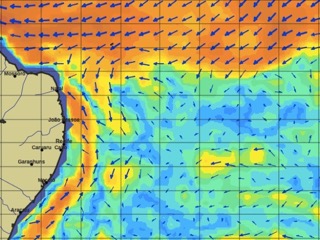
Current

On a different tack altogether, one of the things we do most mornings and evenings is listen to the news on the HF radio.  We've found both the BBC World Service and Voice of America on various AM shortwave frequencies.

The BBC transmits from:
  • Ascension on 6005kHz, 9915kHz, 11810kHz, 15400kHz and 17640kHz; and
  • South Africa on 12095kHz.
VoA transmits on:
  • 6080kHz, 7465kHz, 9885kHz, 15580kHz.

Note that all of these frequencies are active at particular times each day, mainly in the morning and early evening.  You may find other stations transmitting on these frequencies at other times.

Friday, 4 March 2016

St Helena Outbound Day 11

Hi everyone,
We are currently in position 09 44S 024 26W, saillng at 5 knots on a course of 300M. The wind is ESE at 14-16 knots with a 2m SE sea and a 1.5m S swell.  We are sailing under double-reefed main and full yankee.  Scattered small cumulus clouds.  Our day's run was 126nm, our DMG was 99nm and we have 2739nm to go.

Sunrise this morning

Winds have been quiet consistent for the last 24 hours, varying only from 10-16 knots in strength and perhaps 10 degrees in direction.  The sea state has been surprisingly variable so we wonder if there are current eddies about which are alternately smoothing and roughening the seas.  Regardless, we're just letting the boat do the talking (walking?  sailing!) while we read our books, study Winlink/Go! interfacing, watch movies and err… keep a lookout!!!

Several people have contacted us to ask why we don't pole out the yankee to run deeper downwind.  That's easy to answer - we don't have a pole!  I think I've mentioned it in the past but the story is worth repeating.  When we converted Zen Again from a sloop to a cutter rig we needed a halyard for the staysail.  The pole topping lift was ideally located so that's what we used.  Without a topping lift we considered whether we wanted to keep the pole.  My feeling is that manoeuvring spinnaker poles around the foredeck on a small yacht in blue water is one of the most hazardous jobs aboard.  So we decided to get rid of it.  We don't feel its loss generally.  It's only long dead-downwind passages where its absence may slow us down a little.

Yesterday afternoon we wound our clocks back again to UTC-2.  That earned us another weak rum punch to celebrate crossing 22.5 degrees west.  It also moved the morning and evening radio nets (which are fixed to UTC times) to nicer boat times.

For those interested in our Winlink RMS Express to Iridium Go! interfacing problem we now have a pretty good idea of its cause.  We are running RMS Express on Windows in a Parallels virtual machine on our Macbook.  We bridge the Mac's WiFI interface to Windows but Parallels sets it up as an ethernet interface.  The interface works perfectly but RMS Express looks for a WiFi interface and can't find one.  In all other respects RMS Express works perfectly with Parallels so we hope Winlink will address the issue.

Yesterday evening 14 yachts reported in on 6224kHz at 1900utc.  Everyone seems to be enjoying the great sailing conditions.  One boat further ahead suffered slight mainsail damage yesterday but had it fixed within the day.  Another boat has engine problems so is diverting to a port in Brazil to see to it.  We're all preparing ourselves for the ITCZ where we expect calms, sudden squalls and occasional heavy rain. That's still several days away for us but with the main already double-reefed we're well prepared!

Trust all's well where you are.

Thursday, 3 March 2016

St Helena Outbound Day 10

Hi everyone,
We are currently in position 10 48S 023 08W, saillng at 5 knots on a course of 350M. The wind is SE at 15-18 knots with a 2m SE sea and a 1.5m S swell.  We are sailing under double-reefed main and full yankee.  Mid-level overcast.  Our day's run was 137nm, our DMG was 102nm and we have 2838nm to go.

We didn't make as much progress as hoped since the winds decreased overnight and we stuck with the headsail-only rig.  Despite this we did better in DMG than we did for several days "working the angles".  It feels slow but the DMG is what counts.  This is a lesson in patience - as if after 55 years I'm going to get some of that! ;)

Yesterday afternoon winds were 20-25 knots from the ESE and we made good progress with two furls in the yankee.    The wind gradually dropped to 18-22 knots in the evening and then progressively down to 14-16 knots by morning.  The skies were partly cloudy last night.

This morning we've been cruising along under this rig to see how it goes in lighter winds of 12-14 knots.  We were slowing down but happily the wind has filled in a little and we now have 16-18 knots.  At 0900 we gybed onto stbd tack to close the rhumb line to our waypoint.

My reading is becoming more varied as my stock of SciFi eBooks is consumed.  Recently I've read:
  • The Lost World (sorta SciFi-ish)
  • Brave New World (SciFi)
  • Pinnochio (for light relief - I don't think I read it as a boy)
  • The 39 Steps
  • World Without End
We also listen to a lot of BBC podcasts:
  • Desert Island Disks (current and the 600 or so archive episodes)
  • Thinking Allowed (general)
  • Discovery (science)
  • History Extra (yes, history)
  • The Life Scientific (interviews with prominent scientists)
  • The Infinite Monkey Cage (relativity can be funny!)
We used to listen to the ABC's "Starstuff" podcast which had excellent stories of space exploration at it happened.  Sadly it was discontinued in at the end of last year.

I've also been reconfiguring our Icom M802 HF/SSB radio for the Caribbean and North Atlantic.  Things like replacing Australian and South African voice and fax weather stations with US and European stations.  And changing from Indian Ocean cruiser net frequencies to those used in the Caribbean.